Decode Behavior/Programs/Deception Detection
Investigators · Compliance · Security

Deception Detection
for Investigators

Most investigators rely on instinct when reading behavioral signals during interviews. This training replaces intuition with a structured, science-based framework for distinguishing deception from stress, and identifying behavioral inconsistencies before they go unnoticed.

⚠️
An important note on deception detection: No behavioral signal is independently diagnostic of deception. This training is designed to improve behavioral observation and interview effectiveness — not to provide certainty of guilt or innocence. Trained investigators make better decisions with incomplete information. Untrained ones often make worse decisions with the same information.
FormatsWorkshop · Compliance Program
ApproachScience-based · Applied · Live demonstration
EnvironmentsCorporate · Legal · Government · HR
The Problem

Instinct is not a
reliable investigative tool.

Most investigative professionals have developed sharp observational instincts. But instinct without a structured framework produces inconsistent results — and in investigative contexts, inconsistent behavioral reads lead to poor interview decisions, missed signals, and compromised outcomes. The science of behavioral analysis exists. Most investigators simply haven't been trained to apply it.

Stress is routinely misread as deceptionAnxiety, fear of disbelief, and investigative pressure all produce behavioral signals that overlap significantly with deception — and untrained observers conflate them.
Behavioral inconsistencies go undetectedWithout a structured observation framework, meaningful behavioral changes during an interview go unnoticed while irrelevant signals receive disproportionate attention.
Interview technique doesn't create signal conditionsHow an interview is conducted determines what behavioral signals become observable. Poor interview structure suppresses the very signals investigators need to read.
Nonverbal cues are read selectively and inconsistentlyInvestigators without formal training rely on culturally-conditioned assumptions about what deception "looks like" — assumptions that behavioral science has repeatedly disconfirmed.
The Critical Distinction

Stress and deception
look similar. They are not.

The most consequential skill in investigative behavioral analysis is the ability to distinguish anxiety-driven responses from deception-linked behavioral clusters. This training builds that distinction systematically.

Stress Response Signals
What anxiety looks like during interviews
Stress produces predictable physiological and behavioral responses that are frequently misidentified as deception indicators. Recognizing these patterns prevents false reads.
Increased speech rate and vocal tension
Reduced eye contact from fear of disbelief
Physical stillness from controlled anxiety
Verbal over-explanation as a credibility strategy
Memory fragmentation under pressure
Deception-Linked Behavioral Clusters
What structured behavioral analysis looks for
Deception is identified through behavioral clusters and changes relative to an established baseline — not from any single observable signal in isolation.
Deviation from established behavioral baseline
Verbal-nonverbal channel inconsistency
Strategic pause patterns around specific content
Distancing language and narrative compression
Micro-expression flashes incongruent with content
What Organizations Gain

Investigative teams that
read behavior with structure.

01
Improved investigative interview effectiveness
Investigators leave with a structured framework for designing and conducting interviews that create the conditions necessary for meaningful behavioral signals to surface — rather than interviews that suppress them.
02
Sharper behavioral observation skills
Trained observers systematically track behavioral baselines, identify deviations, and recognize clusters of signals that indicate meaningful changes in the subject's behavioral state during questioning.
03
Reliable stress-vs-deception distinction
The most common investigative error is treating anxiety as evidence of deception. Training builds the observational vocabulary to reliably separate these signal categories — reducing both false reads and missed signals.
04
Stronger questioning strategy
Behavioral awareness improves question design, pacing, and sequencing — enabling investigators to use their own behavioral cues strategically and create interview conditions where deception-linked clusters become visible.
Curriculum

What investigators
learn to see.

1
Recognize behavioral indicators during interviewsBuild a structured system for observing behavioral signals across verbal, nonverbal, and paralinguistic channels simultaneously — rather than focusing narrowly on any single cue.
2
Identify verbal and nonverbal inconsistenciesDetect the moments when what a subject says diverges from how their body and voice respond — the cross-channel inconsistencies that signal behavioral load beyond what the content alone would predict.
3
Distinguish stress signals from deception indicatorsApply a structured framework for separating anxiety-driven behavioral responses from deception-linked behavioral clusters — reducing false reads in both directions.
4
Establish and use behavioral baselinesLearn to create the interview conditions that reveal a subject's normal behavioral range — so that meaningful deviations become observable against a reliable reference point.
5
Conduct more effective investigative interviewsApply behavioral awareness to interview structure and sequencing — creating conditions where relevant behavioral signals surface and strategic questioning creates observable behavioral responses.
Why structured training matters
FBI
Behavioral Analysis Program trained — methodology applied to investigative and corporate interview environments
GIB
Global Institute for Body Language — Chris serves as Executive Director, advancing professional standards in behavioral analysis
APA
APA certified methodology — evidence-based behavioral science, not proprietary pseudoscience
Schedule a Training Consultation
What Happens During the Training

Inside the
investigative training session.

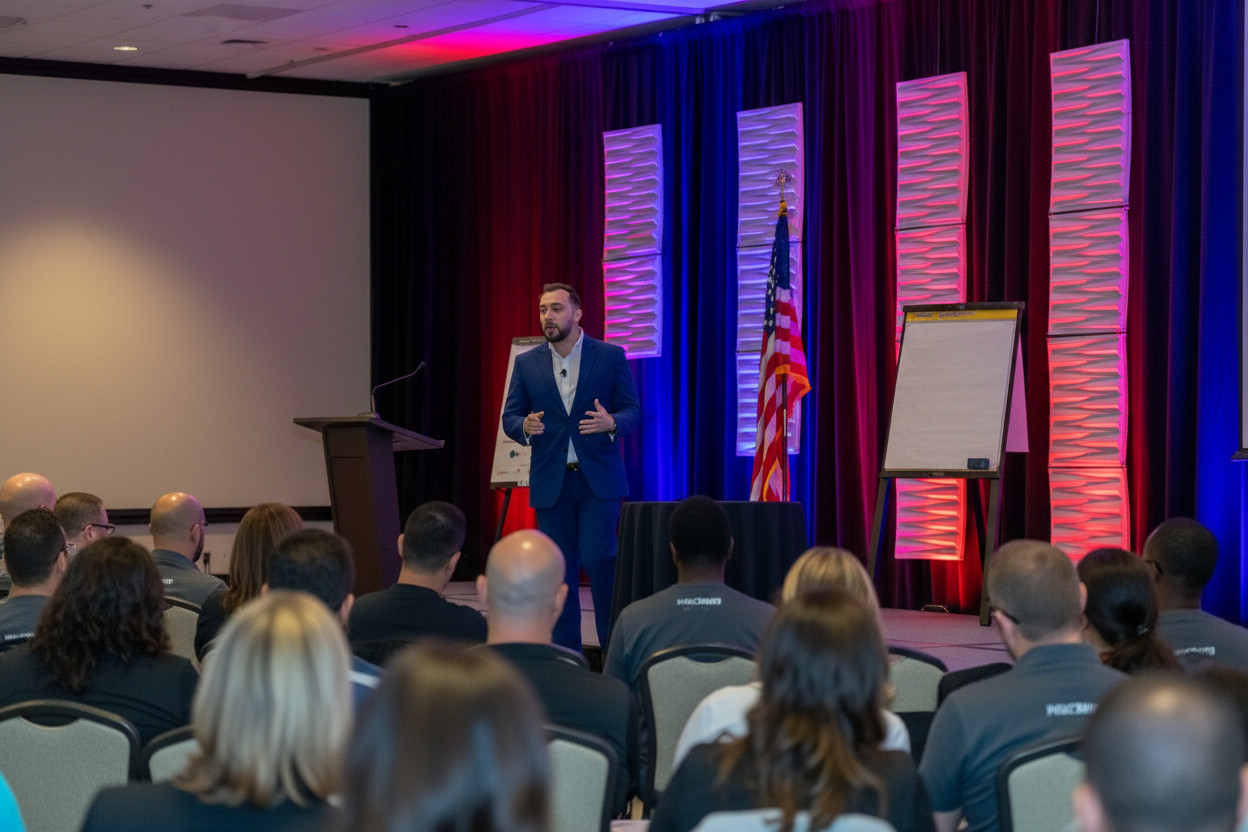
This program is built around live demonstration and applied exercises. Participants don't receive a lecture about deception detection — they watch behavioral signals appear in real time, then learn to recognize and categorize them.

🎭
Live Behavioral Demonstrations
Chris performs controlled live demonstrations where deception, stress, and genuine responses are demonstrated simultaneously — allowing participants to observe the difference between signal categories in real time, with their own perceptions as the test subject.
🎙
Interview Scenario Analysis
Participants work through structured analysis of interview scenarios — identifying the behavioral moments that produced meaningful signal, and the interview techniques that created the conditions for those signals to become observable.
🔬
Behavioral Decoding Exercises
Applied exercises where participants practice reading behavioral clusters, establishing baselines, and tracking deviations across verbal and nonverbal channels. Exercises are calibrated to the specific interview contexts your team navigates.
📁
Case Study Breakdowns
Analysis of real investigative case scenarios — identifying the behavioral signals that were present, how they should have been interpreted, and the interview decisions that would have changed the outcome. Applied directly to your team's investigative environment.
Who This Training Is For

Built for professionals
who conduct interviews.

This program is appropriate for any professional whose role requires behavioral observation, interview conduct, or the assessment of credibility and consistency under questioning.

🔍
Corporate Investigators
Internal investigations, employee conduct, workplace incidents
⚖️
HR Investigation Teams
Employee complaints, policy violations, termination interviews
🛡
Corporate Security Teams
Physical security investigations, insider threat programs
📋
Compliance Officers
Regulatory investigations, audit interviews, vendor due diligence
🏛
Legal & Litigation Teams
Witness interviews, deposition preparation, testimony assessment
🔐
Interview Specialists
Credibility assessment, structured interview design, subject evaluation
Delivery Formats

Available in formats built
for investigative teams.

🗓
Investigative Training Workshop
Half-day or full-day applied behavioral training for investigative teams. Includes live demonstrations, scenario analysis, and structured exercises calibrated to your investigative environment.
🏛
Security Team Training
Behavioral intelligence training scoped for corporate security and insider threat programs. Covers behavioral observation, baseline establishment, and interview technique for security contexts.
📋
Corporate Compliance Program
Multi-session behavioral training integrated into compliance team development. Can include certification pathways aligned with GIB professional standards. Custom scoped.
Chris Michael
Chris Michael
Behavioral Strategist · Executive Director, Global Institute for Body Language

Chris Michael's work sits at the intersection of behavioral science, applied observation, and human decision-making. He has trained investigative professionals, corporate security teams, compliance organizations, and government agencies — applying the same behavioral science framework across investigative and operational contexts. His approach is grounded in evidence-based methodology, not proprietary techniques.
FBI Behavioral Analysis Program APA Certified GIB · Executive Director C4ISR · Government Programs
Schedule a Consultation

Ready to bring structured
behavioral training to your team?

Submit a consultation request and receive a personal response within one business day. We'll discuss your team's investigative environment, training objectives, and the format that fits your program.

Schedule a Training Consultation

Response within 1 business day · All formats available